An experiment with ThreePhase Scanning.
Thursday, November 15, 2012

Projection Mapping Dice
Using my early forepoint tracking code, together with ofxSyphon and MadMapper.
MakerBot Counting Hands
The homework was to turn data collected on a computer into a 3D object.
Integers between 1 and 10 seemed to be the most simple data that I could turn into a three dimensional model and so I decided to use the number gestures using a single hand that I had noticed when in China. I used KinectToStl to get the hand models rendered as STL mesh files from Kinect depth data. After editing the STL files in Meshlab, I outputted the combined files to the MakerBot to print.


Integers between 1 and 10 seemed to be the most simple data that I could turn into a three dimensional model and so I decided to use the number gestures using a single hand that I had noticed when in China. I used KinectToStl to get the hand models rendered as STL mesh files from Kinect depth data. After editing the STL files in Meshlab, I outputted the combined files to the MakerBot to print.


Wednesday, November 14, 2012
SMS Frown Alert
Homework Assignment to build something that pulls facial gesture data out of faceshift in order to actuate something in the real world.
Enter the SMS Frown Alert....
Enter the SMS Frown Alert....
Saturday, November 10, 2012
Staring Contest
Staring Contest from Mark Kleback on Vimeo.
Using the Forepoint algorithm, an Arduino, and a stepper motor, this Kinect can't take its "eyes" off of you.Tuesday, November 6, 2012
Sliced head
For the final class I've decided to combine 3D printing and AR. A pattern is printed on each head's slice. Every pattern is associated with an image of human brain's slice that is projected on top. Slice by slice the user explore the human brain. According to the stimula sent to the brain different images will be projected in order to highlight the different affected area.
Sliced Head from Federico Zannier on Vimeo.
Projection mapping: e-books
I wanted to make my books more attractive and play around with projection mapping.
e-books from Federico Zannier on Vimeo.
3D scanner
For the first assignment we were asked to build a 3D scanner from scratch. I took inspiration from <a href="http://fredtruman.com/3d-sensing-and-visualization-week-01-milk-scanner" title="this" target="_blank">here</a> and I tried to build my own.
3D breakfast from Federico Zannier on Vimeo.
Drawing with a Kinect
Using OpenFramewoks, the challenge for this assignment was to find the 'fore point' from the Kinect's Depth Image and treating it as the tip of a pencil.
I've merged the ribbon example by James Jorge with the Kinect point cloud example by Kyle McDonald.
Hand drawing with a Kinect from Federico Zannier on Vimeo.
Saturday, November 3, 2012
Week 1. Apple.
For the first week's assignment ("make a 3d scanner"), Manuela and I decided to scan and render an apple, taking two approaches.
1) Milk Scan (non invasive)
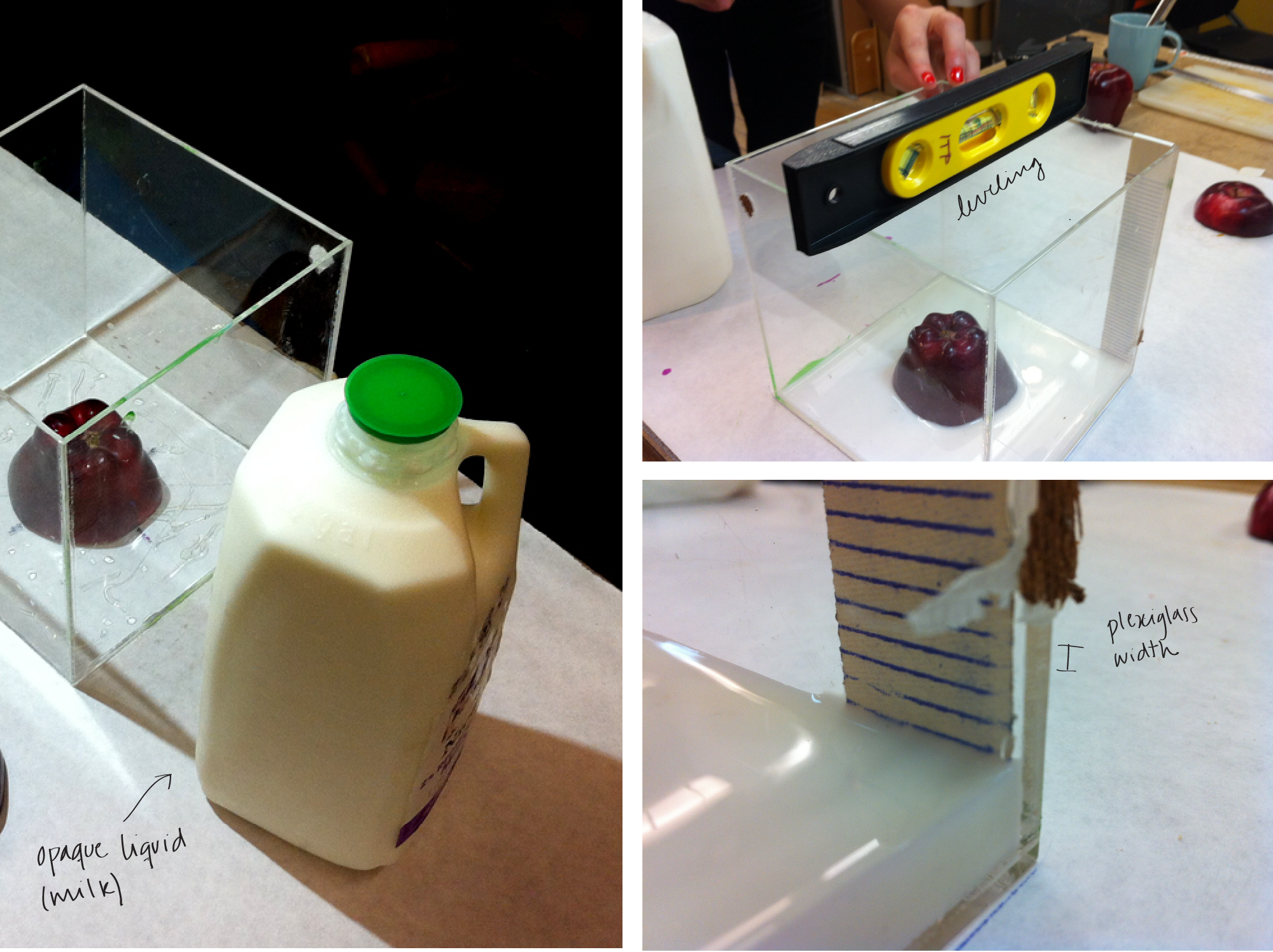
We cut an apple in half, put it in a container, and covered it with milk in layers as tall as a sheet of acrylic that we planned to use to reconstruct it later. Of course this was a serious scientific experiment, and as you can see in the photos we marked registration points, measured the layers of milk, and made sure that the table was level.
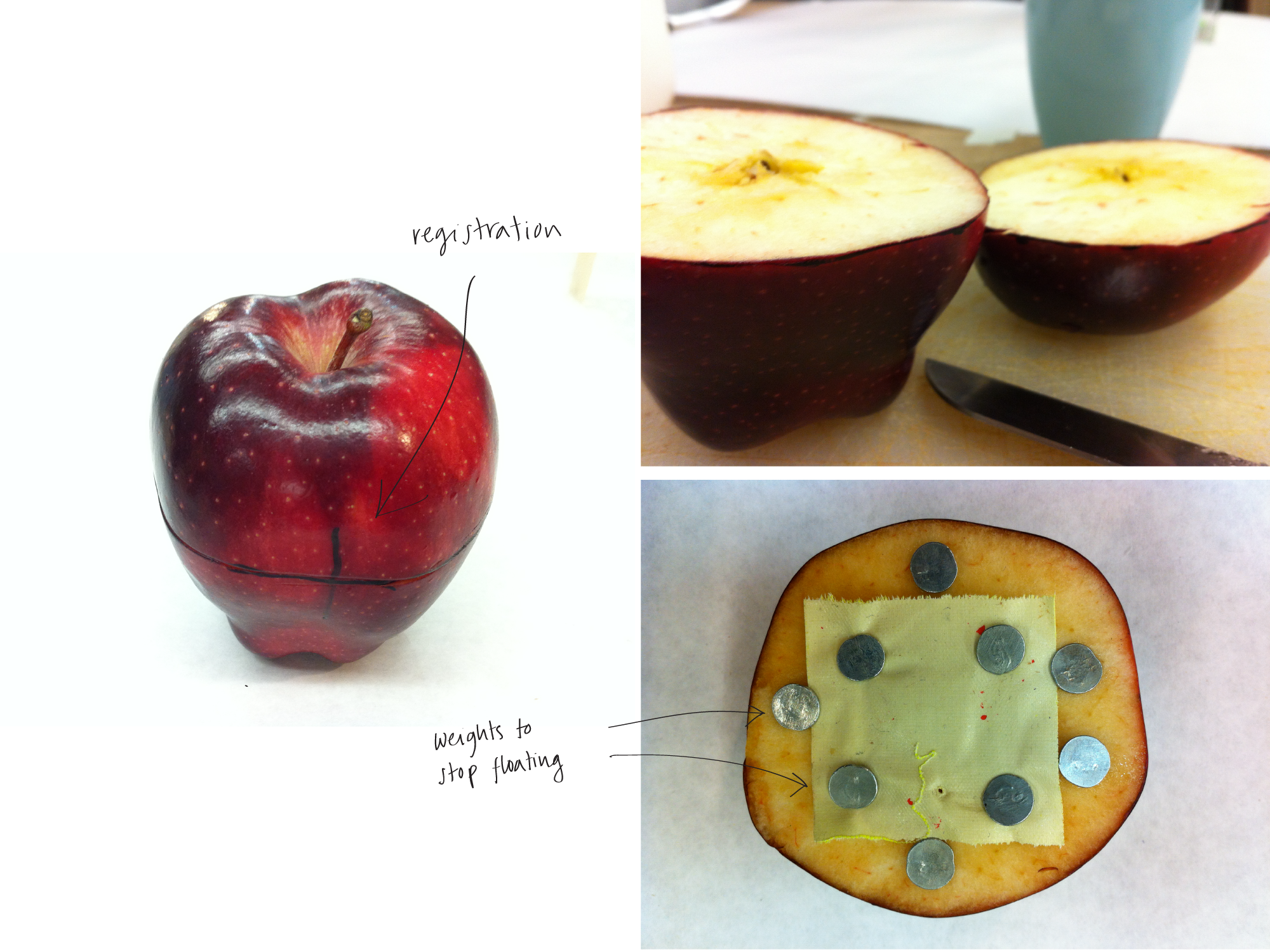
The one problem that we had –the lighter lower half of the apple started to float–, we fixed by punching metal nails into it. So the scan became quite invasive after all...
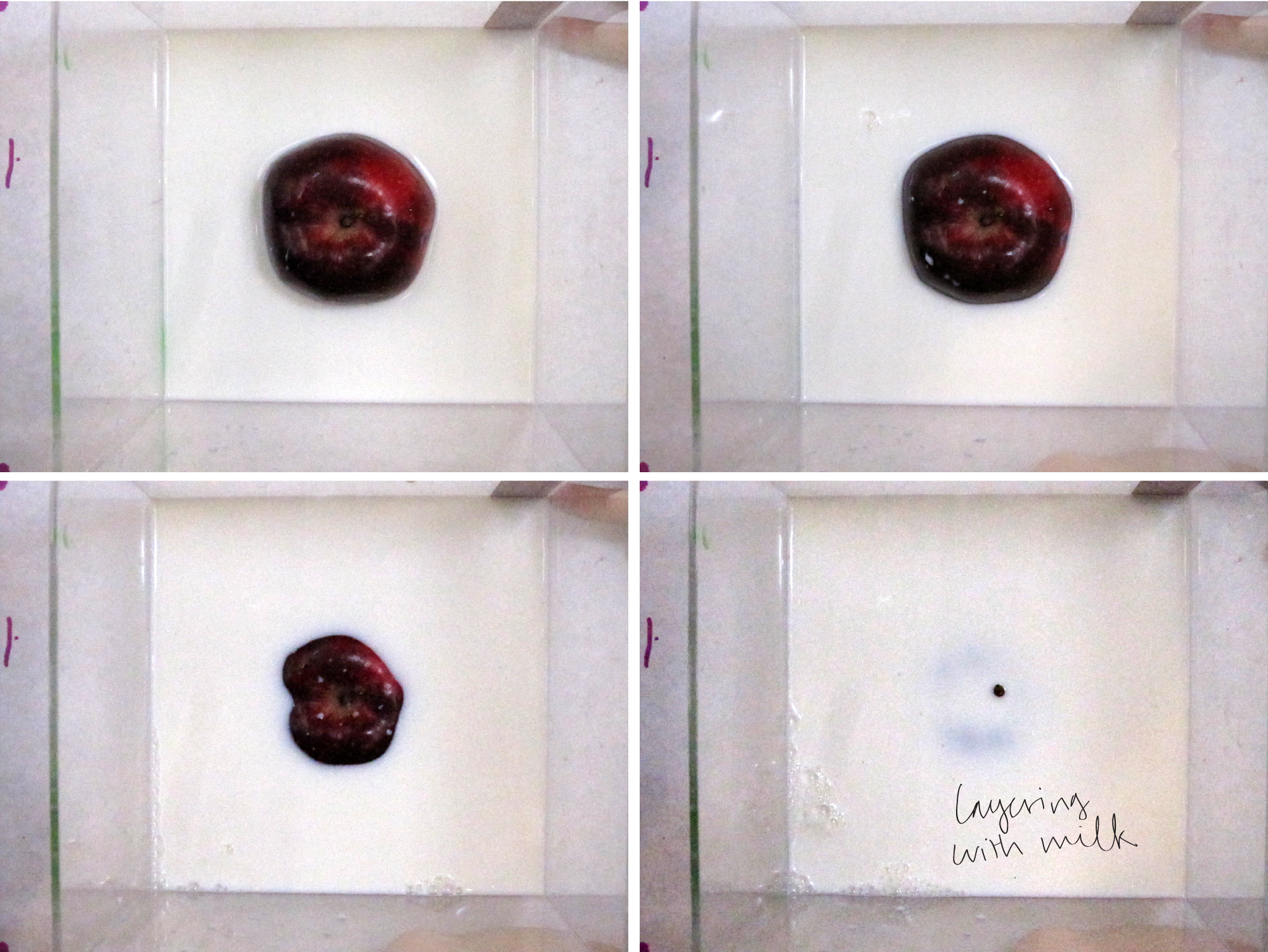
Here is a sample of the photos we took:
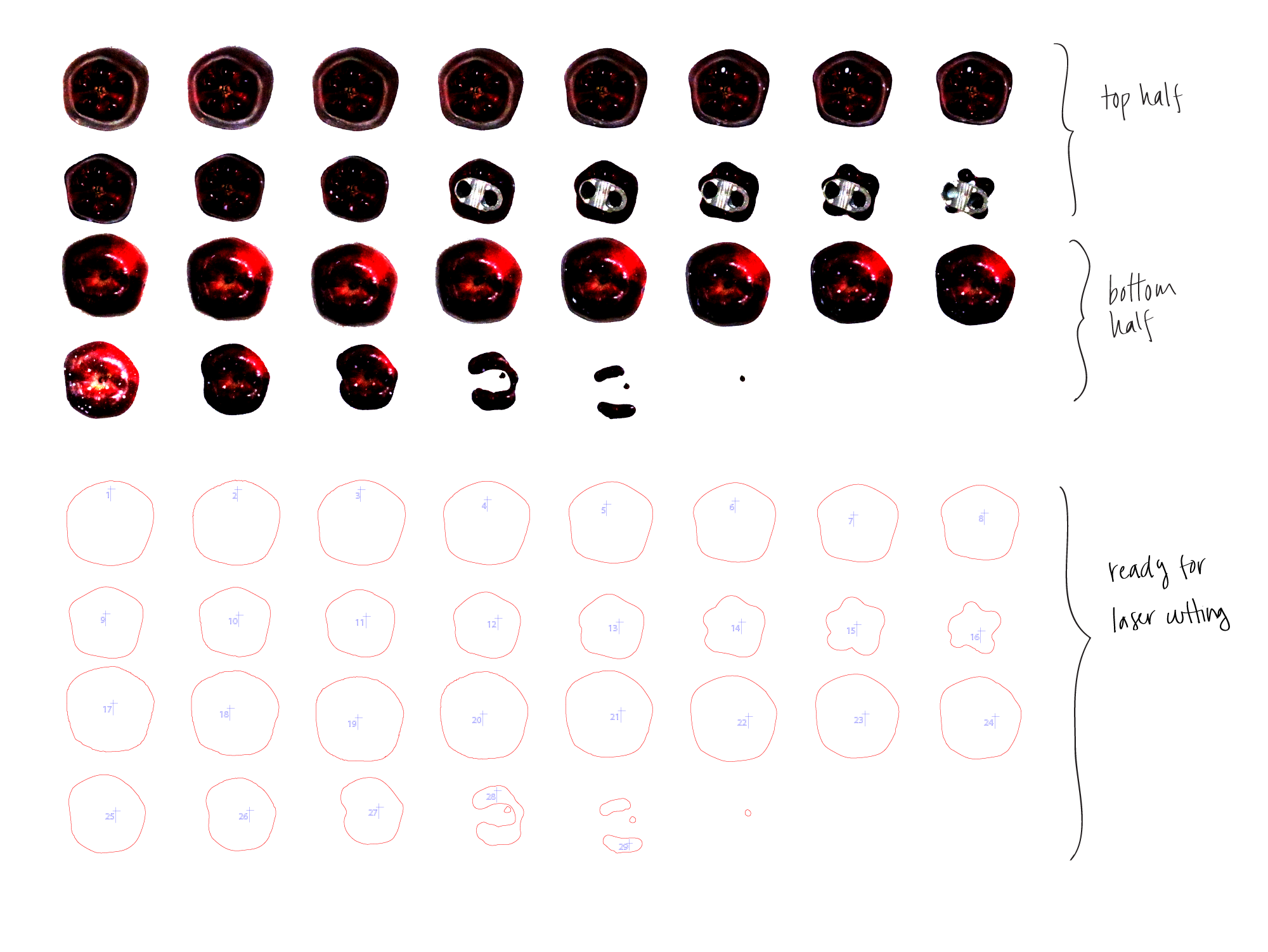
Once we had the images, we processed them to get the outlines to send to the laser cutter, but since the machine was down, we continued with our second plan.
2) Knife Scan (invasive)
For our second scan we cut an apple in thin slices, lit from below so that the details of the texture were visible:
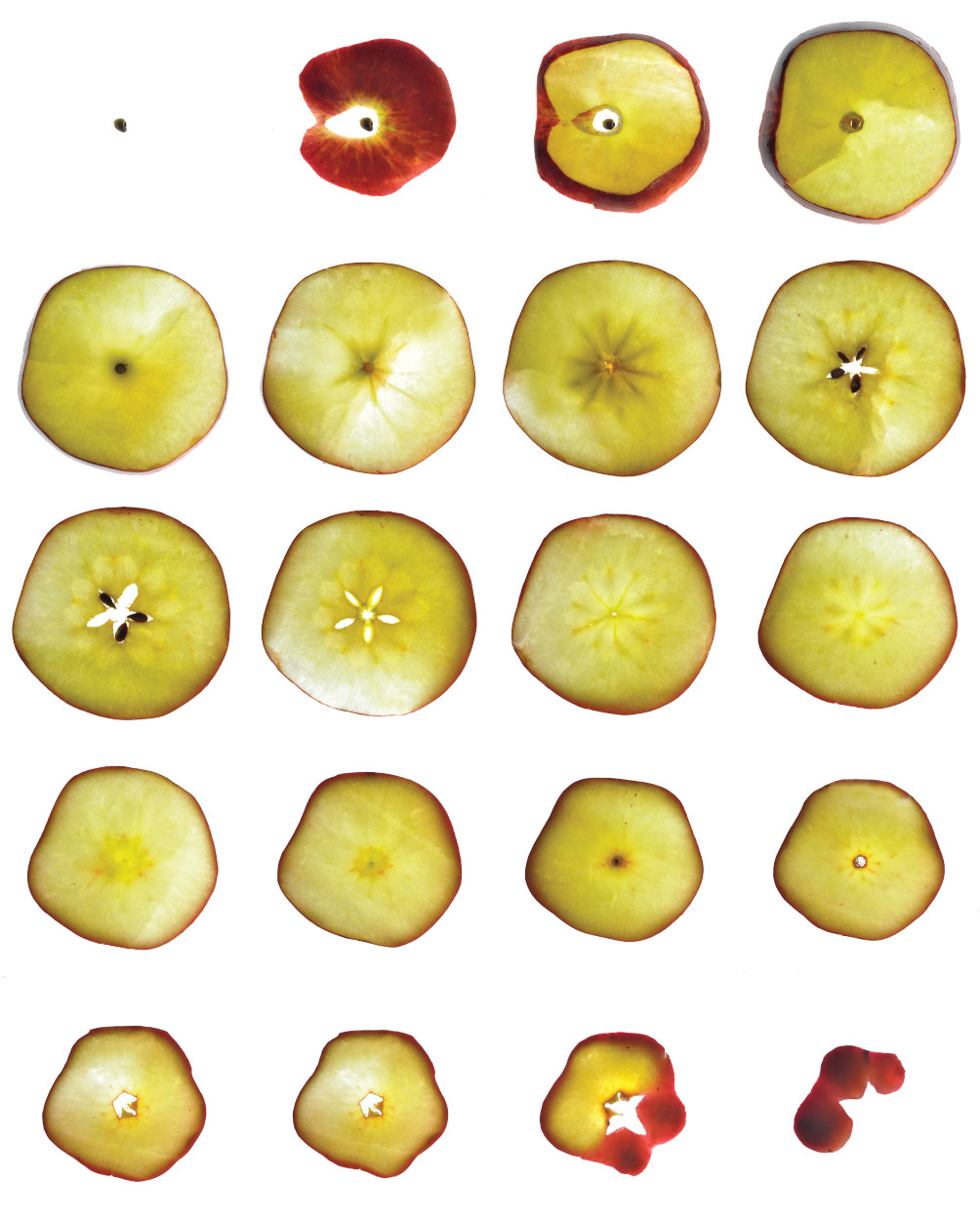
Then we created a gif animation of it:

, made a Processing sketch to reconstruct it:
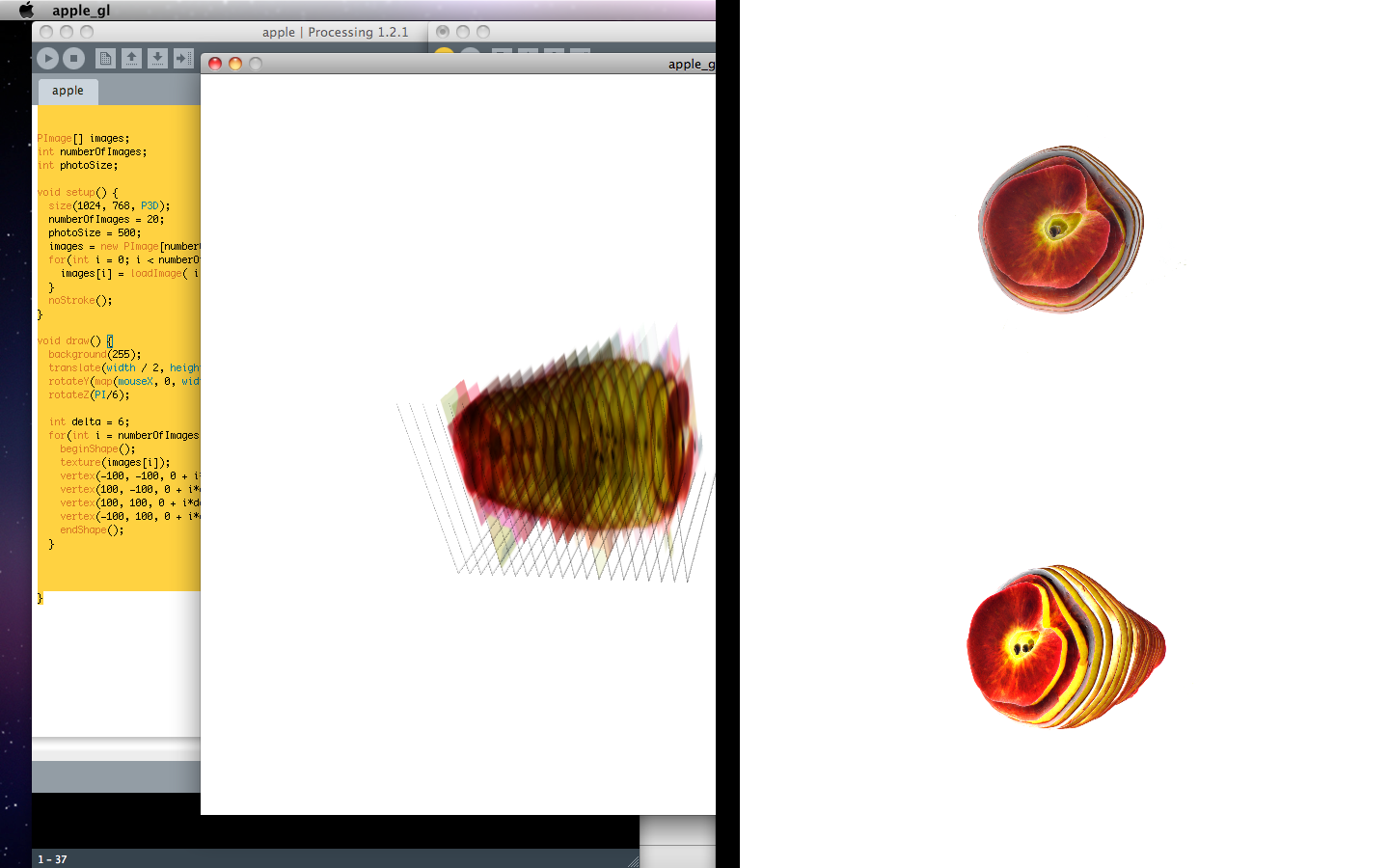
, and finally recreated the effect using Kyle's Slices Example code, from the Appropriating New Technologies class):
Friday, October 19, 2012
Close Encounters of the Schlossberg Kind
TESTING TESTING
testing my alien communication device from r k schlossberg on Vimeo.
AND ACTIONCLOSE ENCOUNTERS OF THE SCHLOSSBERG KIND: V002 from r k schlossberg on Vimeo.
Thursday, October 18, 2012
Transparent screen


Friday, October 12, 2012
little interactive projection mapping exercise
this is just a little prototype..the idea is that once you stick your head into the box, you experience going down and forward as the rings move up...
video is a little confusing as my camera framerate too low..it captures the projector frequency...you are only supposed to see the thin pink stripes


projection mapping tests
first i did a madmapper test on a door
projection mapped door from r k schlossberg on Vimeo.
then i tried to do something which would emphasize the 3rd dimension.. projection-mapped paper crane"enough"; a study of a physical form and overwhelming media information
enough: a study of an iconic physical form and media information from Jee Won Kim on Vimeo.
"How is our experience of a spatial form is affected when the form is filled in with dynamic and rich multimedia information? (The examples of such environments are particular urban spaces such as shopping and entertainment areas of Tokyo, Hong Kong, and Seoul where the walls of the buildings are completely covered with electronic screens and signs; convention and trade shows halls; department stores, etc,; and at the same time, any human-constructed space where the subject can access various information wirelessly on her cell phone, PDA, or laptop.) Does the form become irrelevant, being reduced to functional and ultimately invisible support for information flows? Or do we end up with a new experience in which the spatial and information layers are equally important? In this case, do these layers add up to a single phenomenological gestalt or are they processed as separate layers?" from 'The Poetics of Augmented Space' by Lev Manovich.
[original video footage]
hwa2 from Jee Won Kim on Vimeo.
Thursday, October 11, 2012
The World's Tiniest Projection Map!
I decided to projection map onto my 3D object from last week, and this is what I got.
Subscribe to:
Posts (Atom)